A kundli (also kundali, janam kundli or birth chart) is a map of the sidereal zodiac at the moment and place you were born: the lagna, or rising sign, the twelve houses counted from it, and the positions of the nine grahas. Reading one is less mysterious than it looks. Astrologers work through it in a fixed order, and anyone can learn the order, even if weighing the evidence takes practice.
This guide follows that order, ten steps from the lagna to the dashas, and it mirrors the method JyotishiVani’s AI astrologer follows for every question. It answers the question often asked in Hindi as “kundli kaise dekhe”, and it notes where your birth time matters.
The two ways a kundli is drawn
A kundli has twelve houses, twelve signs and nine planets. North and South India draw the same information in two different layouts.
North Indian chart
The North Indian chart is a square divided into diamonds and triangles. The houses are fixed and the signs move. The 1st house, the lagna, is always the top centre diamond. The houses then run anticlockwise: the 2nd is the triangle to its upper left, the 3rd the triangle below that, the 4th the left-hand diamond, and so on round to the 12th at the top right.
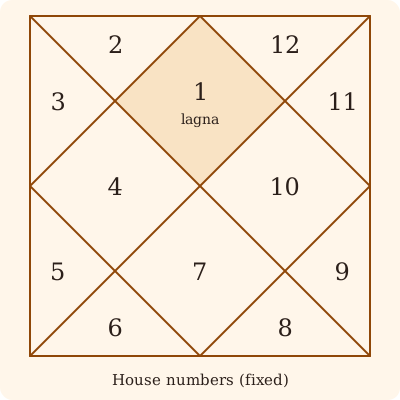
The diagram shows house numbers. In a real chart, the number printed in each house is the sign (1 for Aries, 2 for Taurus, through 12 for Pisces), and the planets are written inside the houses. So a 5 in the top diamond means a Leo lagna; the next house anticlockwise then holds 6 (Virgo), and so on.
South Indian chart
The South Indian chart is a ring of twelve boxes round an empty centre. The signs are fixed and the lagna is marked. Pisces is always at the top left, Aries next to it, and the signs run clockwise: Taurus and Gemini along the top, Cancer and Leo down the right, Virgo to Sagittarius along the bottom, and Capricorn and Aquarius up the left.
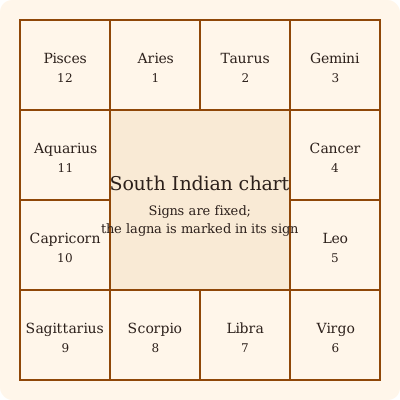
The lagna’s box is marked, usually with a diagonal line or a label such as “La” or “Asc”. That box is the 1st house, and the houses follow clockwise from it. Because the signs never move, a planet in a given sign is always in the same box, which makes two charts quick to compare.
Both layouts carry exactly the same information, and a third, East Indian style is used in Bengal and Odisha. Read whichever you learned first. JyotishiVani draws both.
Step 1: The lagna and its lord
Look at: the sign in the 1st house (the lagna), the planet that rules it (the lagna lord), the house the lagna lord sits in and its dignity there.
It tells you: the lagna fixes the 1st house, so every other house is counted from it. The lagna lord is read for your general direction, vitality and self-expression, and its condition colours the whole chart.
The lagna is also the most time-sensitive part of the birth chart. At Delhi’s latitude it changes sign every 85 to 141 minutes, so a birth near the edge of a sign can flip with a few minutes’ difference. If two apps show you different lagnas, the birth time, the time zone or the ayanamsa usually differs between them.
Step 2: The twelve houses
Look at: which planets sit in which houses, and which houses are empty.
It tells you: which areas of life are emphasised. Each house (bhava) stands for a set of matters. JyotishiVani counts houses as whole signs from the lagna: the lagna’s sign is the whole 1st house, the next sign the 2nd, and so on.
| House | Main themes | Group |
|---|---|---|
| 1st | The self, body and outlook | Kendra and trikona |
| 2nd | Family, wealth and speech | — |
| 3rd | Siblings, courage and communication | Upachaya |
| 4th | Home, mother, property and comfort | Kendra |
| 5th | Intelligence, children and creativity | Trikona |
| 6th | Effort, service, debts and competition | Dusthana and upachaya |
| 7th | Partnership, marriage and the public | Kendra |
| 8th | Transformation, inheritance and what is hidden | Dusthana |
| 9th | Fortune, father, teachers and dharma | Trikona |
| 10th | Career, status and public action | Kendra and upachaya |
| 11th | Gains, friends and elder siblings | Upachaya |
| 12th | Expenses, foreign lands and withdrawal | Dusthana |
House themes as JyotishiVani’s method reads them, after Brihat Parashara Hora Shastra.
The groups matter as much as the single houses:
- Kendras (1st, 4th, 7th, 10th) are the angles. Planets and house lords here are traditionally considered prominent and able to give results.
- Trikonas (1st, 5th, 9th) are associated with dharma, merit and fortune, and their lords are counted among the most auspicious in Parashari reading.
- Dusthanas (6th, 8th, 12th) are associated with obstacles, upheaval and loss or withdrawal. A house lord placed in one is traditionally read as having its results reduced or redirected, always weighed against its dignity.
- Upachayas (3rd, 6th, 10th, 11th) are the houses of growth, where results are traditionally read as improving with time and effort.
Classical texts also read longevity from the 8th house. JyotishiVani explains the tradition but does not make predictions about lifespan or health.
Step 3: The signs and their lords
Look at: the sign on each house and the planet that rules it.
It tells you: who is in charge of each house. Every house has a lord, the ruler of its sign, and the lords carry the houses’ matters wherever they go (step 6).
| No. | Sign | Sanskrit | Hindi | Lord | Element |
|---|---|---|---|---|---|
| 1 | Aries | Mesha | मेष | Mars | Fire |
| 2 | Taurus | Vrishabha | वृषभ | Venus | Earth |
| 3 | Gemini | Mithuna | मिथुन | Mercury | Air |
| 4 | Cancer | Karka | कर्क | Moon | Water |
| 5 | Leo | Simha | सिंह | Sun | Fire |
| 6 | Virgo | Kanya | कन्या | Mercury | Earth |
| 7 | Libra | Tula | तुला | Venus | Air |
| 8 | Scorpio | Vrishchika | वृश्चिक | Mars | Water |
| 9 | Sagittarius | Dhanu | धनु | Jupiter | Fire |
| 10 | Capricorn | Makara | मकर | Saturn | Earth |
| 11 | Aquarius | Kumbha | कुंभ | Saturn | Air |
| 12 | Pisces | Meena | मीन | Jupiter | Water |
Sign lords as JyotishiVani’s engine uses them. The number is the one printed in a North Indian chart.
The Sun and the Moon rule one sign each, the other five planets two each, and Rahu and Ketu none in this scheme.
Step 4: The planets and their dignity
Look at: each planet’s sign, and how comfortable it is there.
It tells you: how fully the planet can give what it signifies. Dignity runs from exalted (uchcha) through moolatrikona, own sign, a friend’s sign, neutral and an enemy’s sign to debilitated (neecha).
| Planet | Exalted in | Debilitated in | Own sign | Moolatrikona |
|---|---|---|---|---|
| Sun | Aries | Libra | Leo | Leo, 0° to 20° |
| Moon | Taurus | Scorpio | Cancer | Taurus, 3° to 30° |
| Mars | Capricorn | Cancer | Aries, Scorpio | Aries, 0° to 12° |
| Mercury | Virgo | Pisces | Gemini, Virgo | Virgo, 15° to 20° |
| Jupiter | Cancer | Capricorn | Sagittarius, Pisces | Sagittarius, 0° to 10° |
| Venus | Pisces | Virgo | Taurus, Libra | Libra, 0° to 15° |
| Saturn | Libra | Aries | Capricorn, Aquarius | Aquarius, 0° to 20° |
The dignity tables JyotishiVani’s engine applies. Moolatrikona ranges differ slightly between texts.
Where exaltation and moolatrikona fall in the same sign, the engine goes by degree: the Moon is exalted in Taurus up to 3° and in moolatrikona after that, and Mercury is exalted in Virgo up to 15°, in moolatrikona from 15° to 20° and in its own sign beyond. The texts disagree about Rahu and Ketu; JyotishiVani’s engine treats Rahu as exalted in Taurus and Gemini and debilitated in Scorpio and Sagittarius, and Ketu the other way round.
A debilitated planet is not a verdict. Classical texts list conditions that cancel debilitation (neecha bhanga), for example the lord of the debilitation sign standing in a kendra from the lagna or the Moon, though they differ on which conditions count. Note too whether a planet is retrograde, or combust (too close to the Sun, which is read as overshadowing it).
Step 5: Aspects (graha drishti)
Look at: which houses and planets each planet aspects, counting the house it occupies as the 1st.
It tells you: which parts of the chart a planet influences beyond its own house. An aspected house or planet is read as coloured by the planet aspecting it.
| Planet | Aspects these houses, counted from itself |
|---|---|
| Sun, Moon, Mercury, Venus, Rahu, Ketu | 7th |
| Mars | 4th, 7th and 8th |
| Jupiter | 5th, 7th and 9th |
| Saturn | 3rd, 7th and 10th |
The full Parashari aspects JyotishiVani applies.
So Jupiter in the 1st house aspects the 5th, 7th and 9th houses; Saturn in the 1st aspects the 3rd, 7th and 10th; and Mars in the 4th aspects the 7th, 10th and 11th. Some texts give Rahu and Ketu the 5th and 9th aspects as well; JyotishiVani does not apply that variant.
Step 6: The house lords and where they sit
Look at: for each house that matters to your question, where its lord sits, in what dignity, and with which planets.
It tells you: how the matters of a house play out. A lord carries its house’s matters into the house it occupies: the 10th lord in the 7th links career with partnership and the public, and the 2nd lord in the 11th links savings with gains. Lords in kendras and trikonas are read as able to give results; lords in dusthanas as having their results reduced or redirected.
Lordship also decides how a planet acts for your particular lagna. Lords of the trikonas are functional benefics; lords of the 3rd, 6th and 11th act as malefics; and a planet that rules both a kendra and a trikona is a yogakaraka, such as Saturn for Taurus and Libra lagnas, Mars for Cancer and Leo, and Venus for Capricorn and Aquarius. When two planets sit in each other’s signs (a parivartana), their two houses are read as closely linked.
Step 7: Read the chart again from the Moon
Look at: the Moon’s sign (your rashi), used as a second lagna, with the houses counted again from it.
It tells you: how the chart looks from the mind’s point of view, and the reference point for timing. Transits are traditionally counted from the Moon sign; Sade Sati is Saturn’s passage through the 12th, 1st and 2nd signs from it; and several yogas are defined from the Moon, such as Gaja Kesari (Jupiter in a kendra from the Moon) and the lunar yogas formed by planets in the 2nd or 12th from it. The Moon’s nakshatra, its birth star, also sets the dasha sequence (see the 27 nakshatras).
A theme that shows from both the lagna and the Moon is read as stronger than one that shows from only one of them.
Step 8: The divisional chart for the matter
Look at: the varga for your question: the navamsa (D9) for marriage and for every planet’s inner strength, the D10 for career, the D7 for children, the D2 for wealth and the D12 for parents.
It tells you: whether the varga confirms what the birth chart promises. A promise repeated there is read as firm; one the varga does not support as weaker. A planet in the same sign in the birth chart and the navamsa (vargottama) is read as steady.
The vargas need a precise birth time: on average a new navamsa rises every 13 minutes and a new D10 part every 12. The guide to divisional charts has the full navamsa table and the birth-time precision each chart needs.
Step 9: Yogas and doshas
Look at: the named combinations the chart forms, and the doshas that apply to your question.
It tells you: patterns the texts single out, always weighed against the strength of the planets that form them. A few common definitions:
- Raja yoga: lords of kendra and trikona houses combine, by conjunction, mutual aspect or exchange of signs; read as supporting status and achievement, especially in the periods of the planets involved.
- Dhana yoga: the lords of the wealth houses (2nd, 11th, 5th and 9th) linked with each other or with the lagna lord; read as supporting the accumulation of resources.
- Gaja Kesari yoga: in its common form, Jupiter in a kendra from the Moon.
- Pancha Mahapurusha yogas: Mars, Mercury, Jupiter, Venus or Saturn in its own or exaltation sign in a kendra from the lagna.
- Manglik dosha: Mars in the 2nd, 4th, 7th, 8th or 12th house from the lagna, by the definition JyotishiVani uses, with the classical exceptions. Some regions also count the 1st house, or count from the Moon or Venus.
- Kala Sarpa dosha: all seven planets on one side of the Rahu–Ketu axis. It is a later concept not found in the major classical texts.
Keep them in proportion. In 200,000 random births across India, the common form of Gaja Kesari appeared in 33% of charts and Budhaditya yoga (the Sun and Mercury in the same sign) in 51%, while Manglik dosha by the definition above appeared in 42% before any exceptions. A yoga found in a third of all charts is not a rare blessing, and a dosha found in more than four charts in ten is not a verdict on a life. See how common yogas really are and Manglik dosha.
Step 10: Timing with dashas and transits
Look at: the running dasha period and sub-period, and the slow planets’ transits over the houses of your question.
It tells you: when the chart’s promises are most likely to come forward. The birth chart describes; dashas and transits time. In the Vimshottari dasha, life runs through a 120-year cycle of periods ruled by Ketu (7 years), Venus (20), the Sun (6), the Moon (10), Mars (7), Rahu (18), Jupiter (16), Saturn (19) and Mercury (17), starting from the Moon’s nakshatra at birth. Each mahadasha divides into antardashas and pratyantardashas, and a period is read as bringing forward what its lord rules and signifies in your chart.
Transits (gochara) are read together with the running dasha rather than on their own. The slow planets matter most: Jupiter stays about a year in a sign, Saturn about two and a half years, and Rahu and Ketu about eighteen months. In the double transit, a method associated with K. N. Rao, a matter is read as more likely to come forward when transiting Jupiter and Saturn both influence its house while a related dasha runs. The transits page lists the dates.
Which house is for marriage, career, money and children?
The same ten steps apply to every question; what changes is the houses, the significators and the divisional chart you look at.
| Question | Main house | Also read | Natural significators | Divisional chart | Jaimini karaka |
|---|---|---|---|---|---|
| Marriage | 7th | 2nd, 11th | Venus, Jupiter | D9 | Darakaraka |
| Career | 10th | 6th, 11th, 2nd | Sun, Saturn, Mercury, Jupiter | D10 | Amatyakaraka |
| Money | 2nd and 11th | 9th, 5th | Jupiter, Venus | D2 | — |
| Children | 5th | 9th | Jupiter | D7 | Putrakaraka |
| Education | 4th and 5th | 9th, 2nd | Mercury, Jupiter | D24 | — |
| Home and family | 4th | 9th (father), 3rd (siblings), 2nd | Moon, Sun, Mars | D4 | — |
The houses, significators and charts JyotishiVani’s method checks for each kind of question.
The natural significators (karakas) are the planets that stand for a matter in every chart, whatever the lagna. The Jaimini chara karakas are assigned by degree instead: the darakaraka is the planet with the lowest degree among the karakas, the amatyakaraka the one with the second-highest. Health and lifespan are not on this list, because JyotishiVani does not read them.
What you can read without a birth time
Without a birth time you still have the planets’ signs, but not the lagna. How much survives depends on how rough the time is:
| Part of the chart | Date and place only | Time within 1 to 2 hours | Time within 15 minutes |
|---|---|---|---|
| Signs of the planets other than the Moon | Yes, except on about 1 day in 8, when one changes sign | Almost always | Yes |
| Moon sign (rashi): Sade Sati, Moon-based transits | 56% of dates | 93% to 96% | 99% |
| Birth nakshatra: dasha sequence, matching | 4% of dates | 84% to 92% | 98% |
| Lagna, houses and house lords | No | Rarely (5% at 1 hour either way) | 75% |
| Divisional charts | No | No | Planets’ signs; the varga lagna needs minutes |
Share of charts in which that part is the same at both ends of the uncertainty window. Computed with JyotishiVani’s engine for every IST day from 1950 to 2010, and for 100,000 random births across India in those years.
The Moon moves about 13° a day and spends about two and a quarter days in each sign, so from a date alone the Moon sign is settled on a little over half of all days; on the rest, any clue to the time, such as morning or night, usually settles it. A nakshatra is 13°20′ wide, about one day’s motion, so the birth star is rarely settled by the date alone. Dasha dates need the Moon’s exact degree: a one-hour error can move them by up to about ten months.
So a reading without a birth time can honestly use the planets’ signs, the Moon sign when it is settled, and the transits counted from it, including Sade Sati. It should not use the lagna, the houses, the house lords, the divisional charts or anything built on them, such as a Manglik verdict counted from the lagna. Rectifying the time from past events can help, but the result is an estimate, not a recorded time.
Common mistakes
- Judging by one factor. “Saturn in the 7th, so marriage will be late” skips nine steps. A single placement is one input; the method weighs all of them, and as step 9 shows, many famous factors are present in a third or more of all charts.
- Treating an empty house as bad. An empty house has no planet in it, nothing more. It still works through its lord, its aspects and the dashas. Every chart has at least three empty houses, and in 200,000 random charts the average was about six.
- Ignoring birth-time precision. A 15-minute error changes the lagna in about one chart in eight, and a 5-minute error changes the navamsa lagna in about 38% of charts. A reading built on a rounded time should say what it cannot know.
- Reading technical words as verdicts. Debilitated, dusthana, Manglik, Sade Sati and maraka are terms of the method, not sentences passed on a life. The texts list cancellations and weigh every factor against the rest of the chart. A reading that pronounces certainty, or ends with something to buy, deserves the most scrutiny.
- Mixing systems. A Western Sun sign read with Vedic rules, or two charts made with different ayanamsas, will not agree. See Vedic vs Western astrology.
How JyotishiVani reads your kundli
- Your chart: the Kundli tab draws your birth chart and its D9, D10, D7, D2 and D12 in North or South Indian style, with each planet’s sign, degree and nakshatra, marks for exalted and debilitated planets, planetary strength, the Manglik and Kala Sarpa checks, Sade Sati and your yogas.
- The same method every time: for any question, Vani works through the houses of the matter, their lords, the karakas, the divisional chart, the yogas and doshas, the running dasha, the slow transits and the ashtakavarga support, then weighs them. Every finding cites the calculated facts it rests on.
- Only what your birth time supports: the app recalculates your chart across your birth-time window, and anything that changes inside it is marked uncertain instead of being used as if it were known.
- Checked: in the live benchmark run of 11 October 2026, all 27,182 calculated values agreed with an independent reference calculation, and 99.6% of 1,383 chart statements in Vani’s answers were correct. The accuracy page explains what was tested.
Look up any term in the glossary, or go deeper with divisional charts, yogas and the Vimshottari dasha.